TUFF BEATS ONLINE STORE
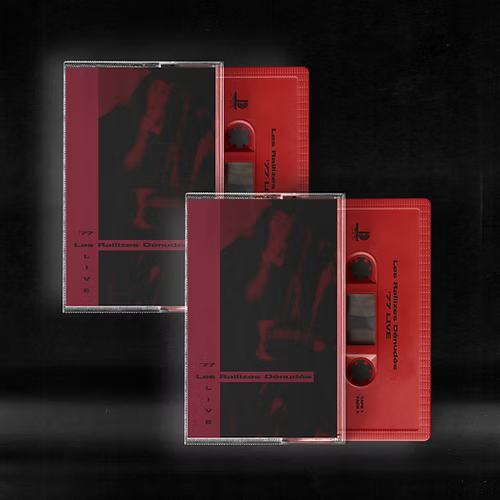
Les Rallizes Dénudés / '77 LIVE (Cassette Tape)
Les Rallizes Dénudés / '77 LIVE (Cassette Tape)
Couldn't load pickup availability
Les Rallizes Dénudés, whose first analog release caused a stir, will release "'77 LIVE" on cassette, a definitive edition featuring a complete recording of their roaring live performance that fully showcases their true essence!
"'77 LIVE," featuring live recordings of Les Rallizes Dénudés' performance in Tachikawa City, Tokyo, on March 12, 1977, is now available on cassette!
It's a chance to re-experience a miraculous hour and a half live performance, filled with an overwhelming deluge of sound and ever-changing improvisation.
----------------------------------
[Commentary on Les Rallizes Dénudés' "’77 LIVE" by Manabu Yuasa]
All mundane thoughts vanished. That's how I felt when I first heard this album in 1991. My entire being was filled with joy. I genuinely felt that there are no limits to music.
This album was released on August 15, 1991, as a two-CD set produced by Takashi Mizutani. It is a live sound recording of Les Rallizes Dénudés' concert held at the Tachikawa Social Education Hall in Tachikawa City, Tokyo, on March 12, 1977.
31 years after its initial release, Makoto Kubota, a former member of Les Rallizes Dénudés, meticulously re-examined the sound sources and remastered them, resulting in this new release.
In 1991, Les Rallizes Dénudés / Takashi Mizutani simultaneously released three albums: "'67-'69 Studio et Live," "MIZUTANI," and "'77 LIVE." When asked about the reason in an interview published in the November 1991 issue of Music Magazine (conducted via fax between Paris, France, and Tokyo; interviewer = this writer), he stated: "There was no context in the usual sense. There were no grand intentions. In our terms, it was a kind of fireworks, or playing with fire. The actual work later became extremely hard."
"When we decided to create the CD, the recording criteria were already in my head without having to think about them. Of course, I hadn't been thinking about it beforehand, but the temporary verbal criteria were from the original formation until the live performance at Bell Commons in the late 70s."
From the formation of Les Rallizes Dénudés in the autumn of 1967 until November 1, 1978, at Aoyama Bell Commons in Tokyo, Les Rallizes Dénudés performed countless live shows. It is also presumed that they made quite a few studio recordings. Mizutani continued, saying:
"I couldn't rest until I had checked all the tapes in our possession from this period. I listened to almost 200 to 300 tapes (mostly 90 or 120 minutes each). It was an amazing period. I was surprised at how difficult it was, even though I'm not easily surprised."
These three works are carefully selected sound sources. They are, perhaps, a conviction of Les Rallizes Dénudés. I believe they represent the expression of Les Rallizes Dénudés as experienced by Takashi Mizutani.
Furthermore, there was persistent and meticulous exploration in converting those tape sources into CDs. Mizutani conveyed:
"At the time of analog-to-digital conversion, I was constantly in the studio. To put it simply, the work involved thoroughly breaking down the somewhat undesirable digital sound to get closer to the original sound. This seemed to be quite hard work for the studio engineers, but the sound that resulted was thanks to their utmost efforts. There must have been parts that had to be discarded for that, but digital sound seems to be a tricky thing."
No sounds were added to the original live recordings afterward. At this time, the difficulty of capturing the sound Takashi Mizutani felt, the sound of Les Rallizes Dénudés that had resonated within Mizutani since March 12, 1977, and putting it onto a single record, can be inferred from Mizutani's statements.
The sound image of "'77 LIVE" is truly rare. It brings forth an unknown auditory sensation. Beyond the distortion, there is further distortion. Between the foreground and background of the sound, they rub against each other, and sound waves expand in all directions. It's not simply that a mass of sound crashes into the listener. One's entire body gets entangled in the sound and cannot escape.
It is likely not something calculated and constructed, but rather something born from various factors overlapping in a mixture of chance and inevitability. Of course, there is acoustic design at the venue. However, you never know what the sound will be like until you play it. Live performances, in particular, are influenced by the conditions of the day. This is completely different from stages controlled by digital equipment as they are today. That is precisely why each remaining sound source encapsulates a different atmosphere and color. Was the live performance on March 12, 1977, a culmination for Les Rallizes Dénudés, who had been active since '67? Or was it a new beginning?
The performers at this time were Takashi Mizutani (guitar, vocals), Takeshi Nakamura (guitar), Hiroshi Narazaki (bass), and Toshiro Mimaki (drums). Nakamura was an original member of Les Rallizes Dénudés. Mimaki was a former staff member of OZ. Narazaki joined Les Rallizes Dénudés after going through Datetenryu and Zunou Keisatsu. Afterward, alongside his own bands, Portkas and Nipritz, he pursued solo activities under names like Hiroshi and Kun Yuri. The rhythm section of Narazaki and Mimaki creates a diverse range of beats. The 12-beat rhythm in "Flame of Ice" evokes Turkish music, "Deeper than the Night" has an R&B feel, and "The Night, Assassin's Night" possesses a pop sensibility reminiscent of "I Will Follow Him." A multifaceted musicality ripples beneath the intensely violent sound.
This time, Minoru Tezuka, who was their manager, contributed a valuable piece describing the situation at the time.
I was surprised to learn that the live performance that day used a 4-way sound speaker system.
Reading the line, "I distinctly remember that the hall's acoustics were incredibly good, sending shivers down my spine," sent shivers down my own spine.
Tezuka also wrote, "It was the day a new Rallizes sound was born, with noise clearly amplified."
Les Rallizes Dénudés continued to progress. Is the incomparably miraculous "'77 LIVE" merely a fragment of Les Rallizes Dénudés?
In the aforementioned fax interview, Takashi Mizutani reminisced:
"Things that fade, things that are sweet
Things that do not fade, yet are still sweet
More so than the sweetness seen in ephemerality
Something precise
The realm of night, space and dimension, and then deviation
Deviation as a result, unintended deviation
When a pre-intended deviation is achieved
Deviation will no longer be on a pre-determined trajectory."
September 2022, Manabu Yuasa
<Notes on '77 Tachikawa LIVE Text by MINORU TEZUKA>
I want to write a little about the Les Rallizes staff members.
In the beginning, Antonio and his team handled the lighting at many venues. The sound company changed occasionally, and there wasn't a dedicated mixer yet, but at some point, Hisashi Kato joined as a mixer.
The lighting team settled on the one led by Taku Yamada.
I met Taku at "Horagai," which was said to be Japan's first rock cafe in Kokubunji, Tokyo.
I think Horagai, which called itself a tribe, was a Mecca for poets, revolutionaries, artists, farmers, and wandering dreamers of the 60s and 70s.
I also frequented it, made acquaintances, and received cooperation for setting up numerous events.
Mako Takashima, the designer who created posters and flyers for us, shared a house with drummer Shunichiro Shoda very close to Japamer Heights in Fussa, where she lived at the time. I believe she was a student at Musashino Art University.
I think it was also him who put up the rose flag that was on the backstage for a while and pasted tie-dyed fabric on the Guyatone amplifier, but my memory is distant.
I believe the photograph chosen by Mr. Mizutani was used for the '77 live poster and flyer.
I took the manuscript to Masanobu Aki Tamura at CCC Printing, an external department of the tribe.
Now, using a photograph by surrealist Hans Bellmer, which probably couldn't be used due to copyright, the text quotes from "The Play of the Doll." In this era, print media was dominant. When I went to put up posters at night, there were posters for Ankoku Butoh and tent theater next to them, and the Rallizes poster placed among them also exuded an unusual presence.
A 4-way surround speaker system was arranged along the walls, and for the first time, a freshly acquired Gibson SG guitar was used.
The rehearsal song was "Reapers of the Night." It was a new song to me, but I immediately knew it would be a success. I vividly remember how incredibly good the hall's acoustics were, it gave me goosebumps.
The recording consisted of two types: one connected directly from the mixer to a cassette, and another recorded by Hiroshi Doronko on open reel with a microphone. It was the day a new Rallizes sound was born, with noise clearly amplified.
Tracklist
TAPE 1
Side A
1. Enter the Mirror
2. 夜、暗殺者の夜 / The Night, Assassin’s Night
Side B
1. 氷の炎 / Flame of Ice
2. 記憶は遠い / Memory is far away
TAPE 2
Side C
1. 夜より深く / Deeper than the Night
2. 夜の収穫者たち / Reapers of the Night
Side D
1. The Last One _1977
Product Information
[Cassette Tape]
Product Number: DRFT07
Released by Temporal Drift / Tuff Beats
Release Date: 2024.2.9