TUFF BEATS ONLINE STORE
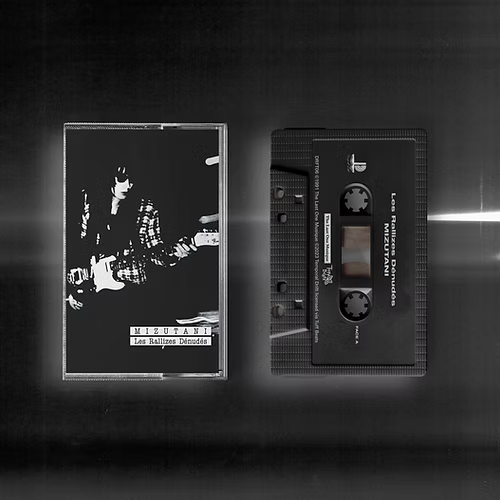
MIZUTANI / Les Rallizes Dénudés (Cassette Tape)
MIZUTANI / Les Rallizes Dénudés (Cassette Tape)
Couldn't load pickup availability
"MIZUTANI / Les Rallizes D_nud_s," focusing on the static side with acoustic sound, to be released on cassette tape!
"MIZUTANI / Les Rallizes D_nud_s," named after Takashi Mizutani of Les Rallizes D_nud_s, will be released on cassette tape! This is an important work that offers a glimpse into Mizutani's personal, acoustic, and introspective side, which is the core of Les Rallizes D_nud_s.
The content is composed solely of unique recordings from the history of Les Rallizes D_nud_s, created when Takashi Mizutani and Makoto Kubota met in Kyoto in 1970.
----------------------------------
[Commentary on Les Rallizes D_nud_s "MIZUTANI / Les Rallizes D_nud_s" by Shinya Matsuyama]
This work is one of three Les Rallizes D_nud_s releases that were issued in limited quantities by Rivista Records in 1991. The Rivista editions, for which Takashi Mizutani himself was involved in track selection and mastering, are the only official works released under the Les Rallizes D_nud_s name. However, each album was released in limited pressings ('77 Live' with 1000 copies, and '67-'69 Studio et Live' and this work 'MIZUTANI / Les Rallizes D_nud_s' with 500 copies), and they quickly disappeared from the market. Since then, they have commanded abnormally high prices in the used market, and bootleg recordings have circulated worldwide. There is no doubt that this reissue, after 31 years and remastered by Makoto Kubota, who was also a member of Les Rallizes D_nud_s for a time, will be acclaimed by fans worldwide.
In October of last year (2021), with the announcement of Takashi Mizutani's death (December 2019) and the launch of the first official website https://www.lesrallizesdenudes-official.com/top/, the "Les Rallizes D_nud_s Reissue/Discovery Project" was initiated, and the label "The Last One Musique" was established by those involved with Les Rallizes D_nud_s. The website clearly states the label's objective: "As the world's sole label holding legal rights to Les Rallizes D_nud_s sound recordings, we will deliver Takashi Mizutani's music with more vivid sound and precise production than the bootlegs that have circulated for over 20 years." In April, "THE OZ TAPES," a two-disc album compiling Les Rallizes D_nud_s tracks (including unreleased material) from the omnibus album "OZ DAYS LIVE" (1973), was released by a US label. However, the reissues (CD and LP) of the three Rivista recordings, all controlled by "The Last One Musique" in every aspect, can be considered the true start of the project.
The 91-year original pressing was limited to only 500 copies, and its content differs from the generally imagined/recognized sound of Les Rallizes D_nud_s, so it may have a low profile among fans. However, I have always considered this work to be one of the most important among all Les Rallizes D_nud_s recordings, including bootlegs. Of course, I also believe that the pleasure brought by the roaring guitar sound covered in feedback noise and the excessively reverberated vocals echoing from the underworld is a special magic unique to Les Rallizes D_nud_s. But Les Rallizes D_nud_s is emphatically not just about roaring sounds. It is impermissible to talk about Les Rallizes D_nud_s solely in terms of roaring sounds. Beyond the violent, destructive roar, there is always a wavering cool and sweet lyricism and eroticism, and in fact, the true essence of Les Rallizes D_nud_s, or Takashi Mizutani, lies there. If one cannot perceive that, one cannot understand the true greatness of Les Rallizes D_nud_s/Mizutani — their noble cruelty and desperate emptiness. This is my firm view of Les Rallizes D_nud_s, having experienced countless live performances since the 70s and listened to an enormous amount of recordings, including bootlegs.
Anyone who has seen their live performances will surely remember. Mizutani would not appear on stage even after the scheduled start time, and the audience would be kept waiting for two or even three hours. In the dimly lit venue, with disco ball lights glittering and cool jazz background music like the Modern Jazz Quartet quietly playing, the audience would simply wait patiently. But I never found it bothersome. I knew that the Les Rallizes D_nud_s live experience had already begun by immersing myself in this dimly lit, chilling space. Because I believed that the depth of loneliness inherent in that suspended silence was the essence of Les Rallizes D_nud_s/Mizutani. I don't think Mizutani was just selfish or capricious in delaying the start; he might have been offering us the unknown waiting time, the abandoned void and anxiety, as a sweet overture that was two sides of the same coin as the loud noise. According to a story Makoto Kubota heard from Mizutani's relatives, Mizutani frequently listened to an organ instrumental version of the theme song from Serge Gainsbourg's film "Je t'aime moi non plus" (performed by Jean-Pierre Sabard, who was responsible for the soundtrack) at full blast in his home. The ecstasy and suffering that drift through that instrumental version can be said to embody Gainsbourg himself, who wandered through the void, oscillating between light and darkness, life and death throughout his life, and I believe the essence of Takashi Mizutani also lay there. And this album most clearly expresses that.
"I'm tired. I want to make quiet music. Will you help me?" Mizutani reportedly said this to Makoto Kubota when they met by chance on the Doshisha University campus in the autumn of '69. From 1968 to 1969, student movements raged across universities in Japan, and members of Les Rallizes D_nud_s (formed in November '67) were in the thick of it. Although Mizutani was loosely associated with the "Kuro-Heru" (anarchist) faction, I am skeptical whether he was truly interested in student activism. Mizutani's reunion with Kubota, a friend from the light music club, occurred shortly after Les Rallizes D_nud_s's concert "Recital as an Indulgence I" at the Kyoto Educational and Cultural Center on October 18, 1969. This was the last concert of the first-period Les Rallizes D_nud_s, and it was also Kubota's first experience of loud rock as an audience member. Kubota originally liked jazz and R&B, and played bossa nova and other genres in the light music club. He was also a home recording enthusiast who enjoyed ping-pong recording with two open-reel tape recorders. Around December, Kubota began visiting Mizutani's apartment, and they started composing songs together while strumming guitars. During this process, they decided to "try recording a demo tape," and tracks 1 to 5 on this album were recorded overnight in a broadcasting room (as it was called) within the Doshisha University student hall. This was reportedly around February 1970.
The broadcasting room had two mono tape recorders, a simple mixer, and microphones. Kubota was familiar with the procedure from his home ping-pong recordings, so the recording process went smoothly. First, a basic track including vocals was recorded in one take. While playing it back, guitars and other instruments were overdubbed onto the second tape recorder. Mizutani sang while playing a Yamaha semi-acoustic guitar, and Kubota played a Martin-like acoustic guitar with a soundhole pickup borrowed from Mizutani. Basically, Mizutani played rhythm guitar and Kubota played lead guitar, but for songs with only one guitar, like "Asa no Hikari" (Morning Light), co-composed by Mizutani and Kubota, Kubota played. At the time, Kubota loved American folk singer-songwriters/guitarists (Richie Havens, Tim Hardin, Joni Mitchell, etc.), and was particularly influenced by the playing style of Bruce Langhorne (the model for Bob Dylan's "Mr. Tambourine Man").
Regarding Tadao Makino, who participated on percussion, Kubota said, "Mizutani-kun brought him. He played by stretching leather or paper over the mouth of a tea caddy and hitting it." His position might be similar to Steve Took during his Tyrannosaurus Rex days. He also played the triangle on "Fragment II," but the glockenspiel on "Morning Light" and "Fissure" was played by Kubota.
Furthermore, Masanori Konno, credited as the lyricist for "Fragment I," is described in various materials as an early member of Les Rallizes D_nud_s, but he was actually a friend close to the band, not a formal member, and was a comrade of Mizutani in the Doshisha Poetry and Song Research Society. Not much is known about Ikko Tsuka, the lyricist for "Fragment II," but it is highly likely to be the person who published a poetry collection titled "Message: Ikko Tsuka Poetry Collection" from the publisher Assassination Order Company in 1971. Moreover, I even suspect that Ikko Tsuka might have been Takashi Mizutani himself... (If so, was "Tsuka" taken from Kunio Tsukamoto, a poet and chansons critic?). The surreal string of words beginning with "Aurora is tobacco smoke..." feels like Mizutani's worldview itself, deeply versed in French literature, especially fin-de-siècle Symbolism.
The trio of Mizutani, Kubota, and Makino continued to perform together for a while after this recording, playing two or three live shows in 1970. One of their earliest recordings is "The Last One _1970" on this album. According to Kubota's memory, this was at a student-organized freshman welcome concert at Doshisha University in May 1970, where they performed alongside Masato Minami and Kenji Endo. Mizutani participated in Masato Minami's album "Kikisen" the following year in 1971, and this concert might have been their first meeting. The performance of "The Last One _1970" also started with Mizutani on rhythm guitar and vocals, and Kubota on lead guitar, but Mizutani suddenly stepped on a fuzz pedal and switched to lead guitar partway through. This is a performance characteristic of Les Rallizes D_nud_s during this transitional period. This song continued to be a representative number for Les Rallizes D_nud_s, but its structure and sound changed with each era, almost to the point of being a different song with the same title. Perhaps for this reason, the "_1970" suffix was specifically added to the song title in this reissue. Please compare it with "The Last One" included in the simultaneously reissued "'67-'69 Studio et Live" and "'77 Live."
The trio version of Les Rallizes D_nud_s with Kubota and Makino later participated in the "Maruyama Odyssey" event at Maruyama Open-Air Concert Hall in Kyoto on September 13, 1970 (also featuring Flower Travellin' Band, etc.). However, around this time, Mizutani was also performing with a group led by Chabo and Fujio Yamaguchi (later Murahachibu), resulting in the peculiar situation where two different versions of Les Rallizes D_nud_s—his own and the one with Kubota's group—performed on the same concert day. Immediately after this concert, in late September, Kubota took a leave of absence from university and went to the US. He returned to university after returning to Japan at the end of March 1971 and joined the newly reformed Les Rallizes D_nud_s (with Mikio Osada on bass and Shunichiro Shoda on drums) that Mizutani had been reorganizing in Tokyo since the autumn of 1970. He occasionally played bass and side guitar at "Les Rallizes D_nud_s 3 Days" at Shibuya BYG in June 1971 (with alternating support acts like Happy End, Masato Minami, Hiro Tsunoda, etc.), the "Shojiko Rockoon" festival in August, and live performances at Kichijoji OZ in 1972-73. However, from 1974, his own band "Yuuyake Gakudan" became busy, and he left Les Rallizes D_nud_s. Kubota's first solo album "Machiboke" (1973), released around the time Yuuyake Gakudan started, also includes a self-cover version of "Morning Light" from this album, which he composed.
And "Romance of Black Sadness," track 6 on this album, which is included only in the CD version of this reissue, is not a trio with Kubota and Makino, but a live recording (Meiji Gakuin University) from 1973 featuring Mizutani, Mikio Osada, Shunichiro Shoda, and Takeshi Nakamura (currently photographer Nakamura _), the original Les Rallizes D_nud_s guitarist who returned as a side guitarist in 1972. The part where the guitar slowly keeps rhythm in the intro would later be absorbed into the ever-evolving "The Last One." The sound of Les Rallizes D_nud_s, as many fans imagine/recognize it, was nearing completion around this time.
Incidentally, Nakamura is the only member other than Mizutani whose performance is included in all three Rivista albums reissued this time (and "OZ DAYS LIVE"). He was a crucial figure who initiated the birth of Les Rallizes D_nud_s (Nakamura approached Mizutani, a friend from the light music club). However, in early 1969, he left the band and began to seriously pursue photography, which he had always loved. But even during the period until he returned to Les Rallizes D_nud_s as a guitarist in 1972, the bond with Les Rallizes D_nud_s was maintained, for example, by him taking photos of their live performances. I visited his photo exhibition held in Kyoto in October 2021, and despite most of the works having no relation to Les Rallizes D_nud_s, the space itself vividly embodied the world of Les Rallizes D_nud_s, and it felt as if it was materializing the essence of Takashi Mizutani mentioned earlier. Nakamura's words that I heard then are still unforgettable.
"This is something that has seeped into my body. Even if the methods of expression are different, that awareness has always been there. And I think it's something I've carried with me ever since the Les Rallizes D_nud_s days. I believe everyone involved with Les Rallizes D_nud_s feels the same way. Meeting Mizutani-san was the origin of everything. Beyond his human charm, everyone felt something more profound and sublimated it in their own way."
Nakamura left Les Rallizes D_nud_s again at the end of 1977, and various musicians joined Les Rallizes D_nud_s thereafter. However, Nakamura's words likely reflect the shared feelings of all members. Takashi Mizutani was both an angel and a devil.
July 28, 2022 Shinya MATSUYAMA
Tracklist
FACE A
1. 記憶は遠い / Memory is far away
2. 朝の光 L’AUBE / Morning Light, L’Aube
3. 断章 I / Fragment I
4. 断章 II / Fragment II
5. 亀裂 / Fissure
FACE B
1. The Last One _1970
Product Information
[Cassette Tape]
Product number: DRFT06
Released by Temporal Drift / Tuff Beats
Release date: 2024.2.9